
The old definition of myopia, and why it falls short
For a long time, myopia was defined by one number: the prescription. If a child needed minus lenses to see the board clearly, they were nearsighted, and each year we would update that number and hand over stronger glasses. The prescription told us how blurry the distance was, and that felt like enough.
It is not enough, and here is the problem. The prescription only tells you the end result of what the eye is doing. It does not tell you why, and it does not tell you where the eye is headed. Managing myopia by the prescription alone is like driving while looking only in the rear view mirror. You can see what already happened. You cannot see what is coming.
The new definition: myopia is the eye growing too long
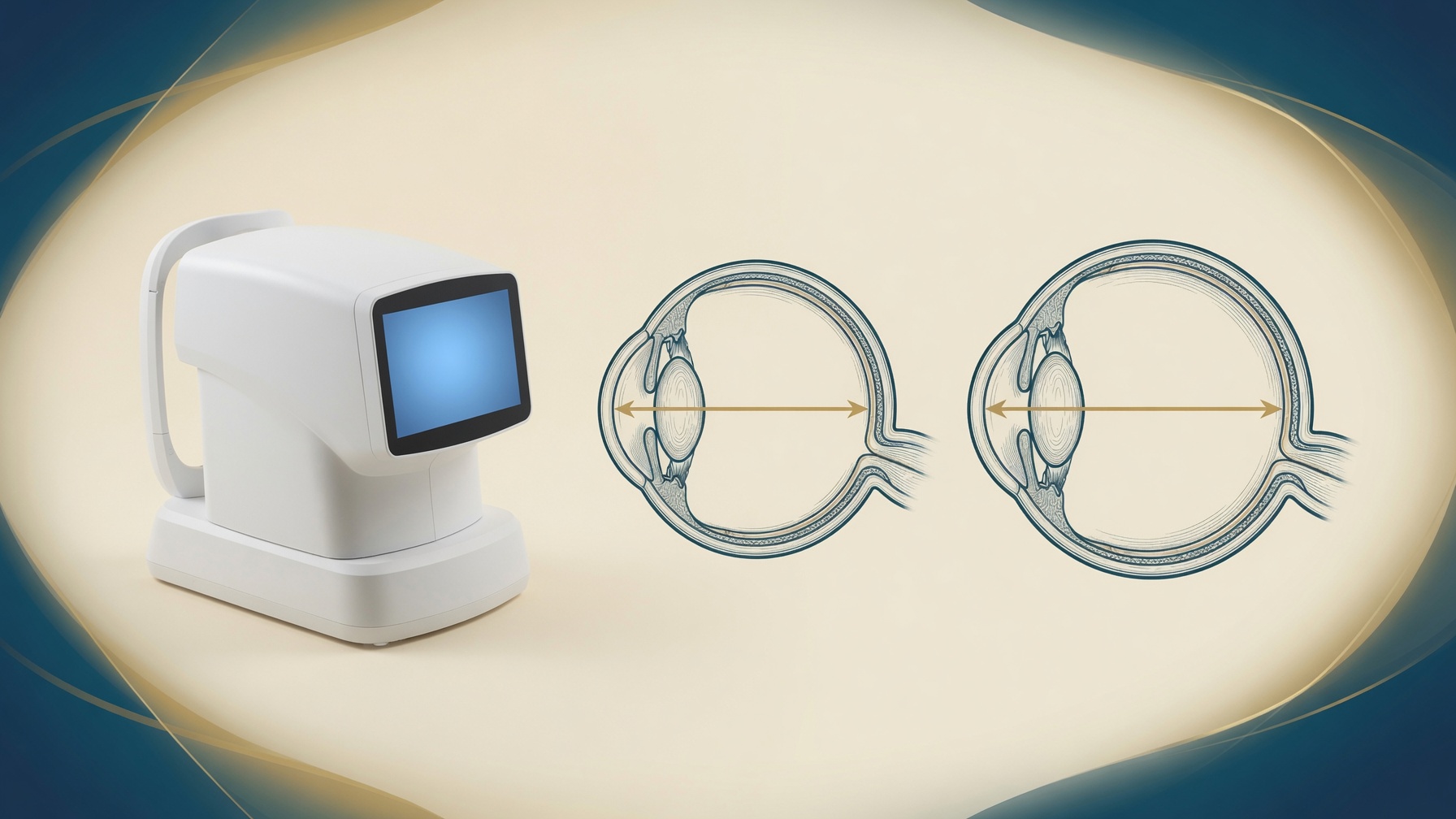
Here is the shift in how eye doctors now understand this condition. Most nearsightedness is axial myopia, which means the eyeball has grown too long from front to back. That extra length is what pushes the focus point in front of the retina and blurs distance vision. The prescription is the symptom. The length of the eye, called the axial length, is the actual structural change causing it.
Why does this matter so much? Because the serious, lifelong risks of myopia rise with how long the eye grows, not simply with how strong the prescription gets. A longer eye means a stretched, thinner retina, and that raises the lifetime risk of retinal detachment, myopic maculopathy, earlier cataract, and glaucoma. These are the outcomes we are truly trying to prevent. They track with axial length. Two children can carry the exact same prescription and yet have very differently shaped eyes and very different long term risk. The prescription hides that. The axial length reveals it.
The glaucoma lesson: measuring the damage is measuring too late
We have been here before as a profession, with glaucoma. For years, glaucoma was managed with two tools: eye pressure and a visual field test. The trouble is that a visual field defect only shows up once you have already lost nerve fibres. By the time the test caught the change, real, permanent vision had already been lost. We were measuring the damage after it happened.
Then OCT imaging arrived and let us see the structure of the optic nerve directly. Suddenly we could catch thinning before the visual field ever changed, before the patient lost a single bit of vision. It moved us from reacting to damage to preventing it.
Axial length is the same leap forward for myopia. Watching the prescription is like watching the visual field: it tells you about change after it has taken hold. Measuring axial length is like the OCT: it looks at the structure itself, so we can see the eye lengthening and act early, before the child is locked into a high prescription and the higher disease risk that comes with it.
Why the prescription alone can fool you
The prescription is actually the sum of several parts of the eye working together, mainly the length of the eye, the curve of the cornea, and the power of the lens inside. Because it is a sum, one part can quietly hide another, and the same prescription number can mean very different things. In practice this fools you in two opposite directions, and we have seen both firsthand.
Direction one, a normal prescription hiding a long eye. In young children a growing lens can flatten and thin to compensate for a longer eyeball, so the prescription stays stable or even reads as no prescription at all. One of our own optometrists, Dr. Phil Xue, has a son who shows exactly this. At six years old his prescription is plano, essentially perfect, the kind of result that gets a child sent home with nothing to flag. But on the biometer, his axial length already measures close to that of an average eighteen year old. His eye has grown far faster and further than it should have for his age. Without biometry that would have been completely invisible, and we would have waited years, until a prescription finally appeared, to learn he was on a concerning path. Because we measured it, we can watch him closely and act early, while there is the most to protect.
Direction two, a rising prescription with no way to know why. The opposite case is a child already doing the right things, on low dose atropine and specialty contact lenses, whose prescription still keeps climbing. Is the eye itself still lengthening despite treatment, or is something else shifting? A practitioner measuring only the prescription is left to estimate, maybe it is working, maybe it is not, let us wait and see. With axial length we look at the eye directly and see whether it is still growing, which answers the real question and lets us hold the plan or change it with confidence. That is the difference between guessing and knowing.
And when axial length is not high and the eye is not racing longer, we still recommend myopia control lenses. Treatment protects the structure of the eye over years, not only today's glasses number. What changes is the conversation: we can explain that other parts of the eye can still shift the prescription even while length is under control, so parents get a clearer answer and more confidence the plan is still working where it matters most.
This is pillar one: precise ocular biometry
Everything above is why the first pillar of our myopia management program is precise ocular biometry. If axial length is where the real risk lives, then measuring it accurately is the data the whole plan depends on. Doing myopia management without axial length is doing it without the full picture. You can still treat, but you are treating partly blind, unable to see the mechanism behind the change or whether your treatment is truly working.
Our biometer captures axial length in a quick scan with nothing touching the eye, along with corneal curvature and more, so Dr. Lin can see how each child's eye is built and how it is changing over time. From there, the other three pillars follow: turning those measurements into a clear picture of risk, matching a treatment to the child, and tracking the trend to confirm it is working. You can read how the treatment options work in our myopia control guide.
The takeaway for parents is simple. When you are choosing where to manage your child's myopia, ask whether they measure axial length, not just the prescription. It is the difference between watching the rear view mirror and actually seeing the road ahead.
Surrey myopia and axial length FAQ
What is the difference between refractive myopia and axial myopia?
Refractive myopia is measured by the glasses prescription, how much minus power the eye needs to see clearly in the distance. Axial myopia describes the physical cause behind most nearsightedness, the eyeball growing too long from front to back. The prescription is the symptom you can read on a chart. The axial length is the structural change driving it, and it is the measurement most closely tied to long term eye health.
Why is axial length more important than the prescription?
The long term risks of myopia, including retinal detachment, myopic maculopathy, earlier cataract, and glaucoma, rise as the eye grows longer, not simply as the prescription grows stronger. Two children with the same prescription can have very differently shaped eyes and very different risk. Tracking axial length measures the disease process directly, which is why the international standard of care now recommends monitoring it alongside the prescription.
Can a child have a normal prescription but still be at risk?
Yes. In young children the lens inside the eye can temporarily mask a longer eye, so the prescription reads normal or even zero while the axial length is already ahead of where it should be for the child's age. Without a biometer to measure the eye directly, that hidden risk is easy to miss. This is exactly why we measure axial length rather than relying on the prescription alone.
How is axial length measured?
With an optical biometer, a quick scan where nothing touches the eye. In the same scan it captures the axial length along with corneal curvature and other measurements, giving a full physical picture of how the eye is built and how it is changing over time. It is painless and takes seconds, which makes it easy to repeat at each visit to track the trend.
Is axial length monitoring covered by MSP?
A full eye exam is covered yearly by MSP for children 18 and under, and that exam is where we take the baseline measurements and decide whether myopia management is right for your child. The ongoing myopia control program, including repeated biometry and treatment, is a separate program and is not covered by MSP. We direct bill most insurance plans and explain all costs clearly before starting.
This article is for general education and is not a substitute for a personalized eye examination. Sources include the International Myopia Institute reports and published clinical research on axial elongation and the long term risks of high myopia.